
Medical Negligence: Before You Sign a Consent Form — What the Law Says About Informed Consent and When a Doctor Can Be Liable
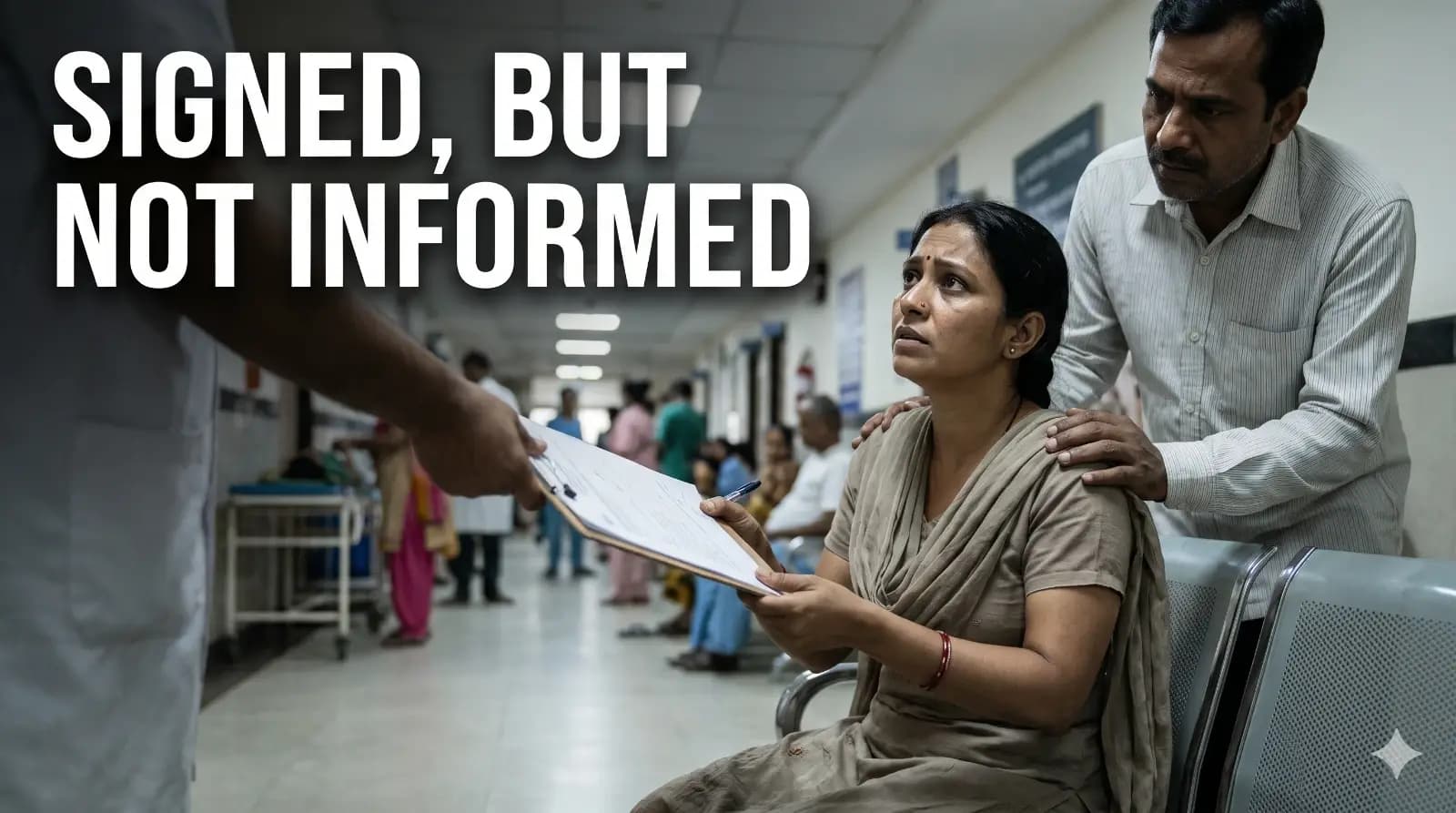
A signature on a hospital consent form is not, by itself, proof that you agreed to what happened. The law asks a different question: were you told enough to make a real choice? This is the doctrine of informed consent, and it sits at the heart of many medical negligence claims.
What Informed Consent Actually Means
Informed consent is not a formality. It is a process by which a doctor gives a patient the information needed to decide whether to undergo a procedure. That includes the diagnosis, the nature of the proposed treatment, the material risks and side effects, the expected benefits, and reasonable alternatives — including the option of no treatment. The patient must also be competent to decide and must give consent freely.
A form that lists risks in dense fine print, signed minutes before surgery, rarely satisfies this standard. Courts look at whether the patient understood, not merely whether they signed.
Why a Signature Alone Is Not Enough
Hospital consent forms often serve the hospital's record-keeping more than the patient's understanding. A typical scenario: a patient is handed a form in a busy pre-operative area, told to sign at the bottom, and given no explanation of a known complication that later occurs. The form may say the patient was counselled, but if no one actually explained the risk, the consent is hollow.
When a complication that should have been disclosed occurs, the question becomes: would a reasonable patient, properly informed, have chosen differently? If the answer is yes, the doctor may be liable for failing to obtain informed consent — even if the procedure itself was performed competently.
When a Doctor Can Be Liable for Consent Failures
Liability for informed consent arises when a doctor fails to disclose a material risk that a reasonable patient would want to know, and that risk materialises, causing harm. The burden lies on the patient to show that the information was withheld and that a reasonable person in their position would have declined the treatment had they known.
Indian courts have consistently held that a doctor must explain the nature of the procedure and its risks in a language the patient understands. A mere signature on a standard form does not discharge this duty. However, the law also recognises that a doctor need not disclose every remote risk — only those that are material to the decision.
The Doctor's Duty to Disclose and the Patient's Right to Know
Under the Indian Medical Council (Professional Conduct, Etiquette and Ethics) Regulations, 2002, and the general law of negligence, a doctor has a duty to provide sufficient information. The patient has a corresponding right to be told about the diagnosis, the prognosis, the risks of the proposed treatment, and the consequences of refusing it.
In practice, courts are unconvinced by consent forms that are generic, unsigned by the doctor, or signed by a relative without the patient's involvement. What judges look for is evidence of a real conversation: a note in the case record, a translated explanation, an opportunity for questions.
Common Mistakes Patients Make (and What They Cost)
One common mistake is signing whatever is placed in front of you without asking questions. Another is failing to keep a copy of the consent form or any written information given. A third is assuming that because a form was signed, there is no case — when in fact the absence of proper counselling may itself be the case.
These mistakes cost patients the evidence they need later. Without a copy of the form or a record of what was explained, proving that consent was uninformed becomes difficult.
What to Check Before You Sign: A Practical Checklist
Before signing any consent form, ask: What is the diagnosis? What is the procedure and why is it needed? What are the material risks and how often do they occur? What are the alternatives, including doing nothing? Who will perform the procedure? What happens if something goes wrong?
Ask for the explanation in a language you understand. If you do not understand a term, say so. Ask for a copy of the form you sign. If possible, have a family member present as a witness. These steps are not adversarial — they are the basis of a genuine informed consent.
What to Do If You Believe Consent Was Not Informed
Gather your medical records, including the consent form, discharge summary, and any correspondence with the hospital. Note the timeline of what was explained and by whom. If you believe a material risk was withheld and harm resulted, you may seek legal advice on whether to pursue a claim in negligence before the appropriate forum — the consumer commission, civil court, or in some cases the medical council for disciplinary action.
Time limits matter. Under the Consumer Protection Act, 2019, a complaint must generally be filed within two years of the cause of action. For civil suits, the Limitation Act, 1963 applies. Do not delay in seeking advice once you suspect that consent was not properly obtained.
Informed consent is a patient's right, not a hospital formality. Understanding it before you sign is the first step in protecting yourself.
Facing a similar situation? Talk to a BKA advocate before you act.
Chat on WhatsAppNeed help with this?
Our Medical Negligence services
Frequently Asked Questions
Is a signed consent form enough to protect a doctor from a negligence claim?
No. A signed form is evidence, but it does not replace the duty to explain material risks and alternatives. Courts look at whether the patient was actually informed, not just whether they signed. If a risk was withheld and harm resulted, the doctor may still be liable.
Doctor ne consent form sign karwa liya, ab negligence ka case banega? (The doctor got a consent form signed; can I still file a negligence case?)
Yes, you can. The form itself does not bar a claim if you can show that you were not properly informed about material risks or alternatives. The focus is on whether the information was actually given, not merely on the signature.
What risks must a doctor disclose before a procedure?
A doctor must disclose risks that are material to the patient's decision — those that a reasonable person would want to know. Remote or very rare risks may not need disclosure, but common or serious side effects generally must be explained.
Can a relative give consent on behalf of the patient?
A relative can give consent only if the patient is unable to decide for themselves, such as in an emergency or when the patient lacks capacity. Otherwise, the patient's own informed consent is required.
Where can I file a complaint about lack of informed consent?
You can file a complaint before the consumer commission under the Consumer Protection Act, 2019, or a civil suit in court. In some cases, a complaint to the State Medical Council for disciplinary action may also be appropriate. Time limits apply, so seek advice promptly.
Related Articles
How to Prove Medical Negligence in India: 12 Documents to Collect Before Filing
A straightforward checklist of the 12 documents you must gather before filing a medical negligence case in India, explained by a senior advocate. Learn what to collect, why it matters, and the common mistakes to avoid.

Birth Injury Medical Negligence in India: A Step-by-Step Guide to Filing a Consumer Complaint
A birth injury claim in a consumer forum depends on picking the right forum, meeting the limitation period and holding the right medical evidence.

Anti-Paper Leak Law Gets Stronger: How the 2026 Amendment Builds on the 2024 Act
In-depth analysis of the 2026 amendment to India's anti-paper leak law, explaining its key provisions and how it enhances the earlier 2024 Act.